

Why raw materials are now the front line of global strategy
Europe’s materials moment: Why raw materials are now the front line of global strategy
Comment by Roman Stiftner, Director General of EUMICON
There are moments in Europe’s industrial history when events in Brussels reveal something larger than a week of conferences and carefully timed policy announcements. Raw Materials Week 2025 was one of those moments not because of any sudden breakthrough, but because the mood in Europe has unmistakably shifted. For the first time in decades, the continent is speaking openly about what it truly takes to remain a secure, competitive, technologically sovereign power: materials.
For years, raw materials were the backstage crew of the European project — indispensable, yet largely unseen. Today they stand centre stage. In a time when supply chains shape strategy and resources influence global politics, minerals and metals have become a new source of power. And in this new geopolitical grammar, Europe must become fluent quickly.
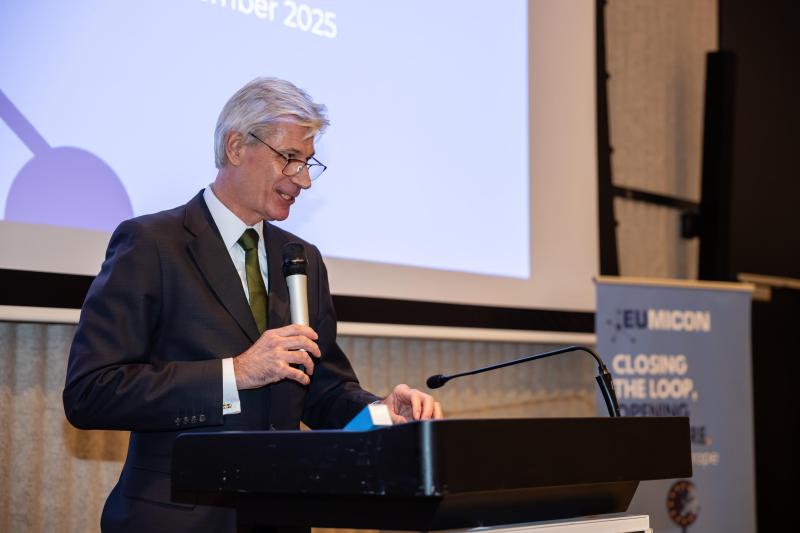
This year’s Raw Materials Week made that clear. Across a series of bilateral meetings, high-level discussions, and a flagship conference co-organised by EUMICON, one message consistently emerged: Europe is navigating a world in which access to raw materials is no longer just an economic question but a matter of political agency. The raw materials community is no longer lobbying for attention, it is shaping the debate about Europe’s place in global competition.
Europe at the centre of global competition
To understand why Europe has reached this inflection point, consider the geopolitical landscape. The world’s major economies (the United States, China, India, Japan, South Korea) are building industrial strategies anchored in secure, long-term access to critical minerals. They subsidise extraction, streamline permitting, negotiate strategic alliances, and intervene directly to secure domestic value chains. In Washington, Canberra, or Seoul, industrial policy is not a debate; it is a reality.
Europe, by contrast, is still wrestling with its regulatory reflexes. Its ambition is enormous — climate neutrality, digital leadership, resilient industries — but without the materials to build the technologies that deliver these objectives, ambition risks drifting into abstraction.
Raw materials policy is not glamorous. It requires geological realism, long-term investment, heavy infrastructure, and cross-border coordination. But without it, none of Europe’s plans from electric mobility to semiconductors, from defence preparedness to renewable energy can be achieved at scale.
This is why Raw Materials Week 2025 resonated so strongly. Europe is finally acknowledging what practitioners have long known: that sovereignty begins underground.
From regulatory acts to real action
The European Union has produced a series of major legislative instruments in recent years — the Critical Raw Materials Act (CRMA), the Clean Industrial Deal, CBAM, and forthcoming instruments on circularity and climate. These are essential steps. But legislation without execution is a blueprint without builders.
During the High-Level Conference, which EUMICON co-organised alongside the European Commission, a recurring theme emerged: Europe must pivot from regulatory production to regulatory coherence, from multiple frameworks to one coordinated industrial strategy. The continent does not lack rules; it lacks alignment. And alignment is what turns policy from aspiration into capability.
Industry leaders, researchers, policymakers, and civil society representatives echoed the same concerns: fragmented permitting, contradictory rules between Directorates-General, inconsistent definitions for secondary materials, unclear energy frameworks, and slow, multi-layered reporting obligations. These are not abstract frustrations — they are delays that cost Europe investment, jobs, and strategic opportunity.
Europe must replace regulatory fragmentation with regulatory direction. It does not need more complexity; it needs a single compass.
EUMICON’s contribution: convening Europe’s industrial backbone
EUMICON entered Raw Materials Week this year with a clear mandate: bring the right people together, create a space for solutions, and ensure the raw materials value chain speaks with one coherent voice. Our role has never been merely to represent industry interests. Our mission is broader: to provide Europe with the platform it needs to connect mining, processing, metallurgy, recycling, innovation, technology providers, academia, labour, and policymakers.
In short: EUMICON is Europe’s bridge-builder for raw materials.
During the week, EUMICON hosted or participated in:
- A series of bilateral meetings with Director-Generals across European Commission portfolios — trade, energy, climate, competition, defence, customs — to strengthen cross-DG coordination.
- A dedicated meeting with Commissioner Jessika Roswall, focusing on circularity, scrap markets, regulatory clarity and Europe’s waste-to-resource transformation.
- Dialogues with Members of the European Parliament, including leading voices on industrial policy and competitiveness.
- A high-level dinner with DG GROW, where Europe’s industrial priorities were discussed with candour and strategic depth.
- And most prominently, the High-Level Conference of Raw Materials Week, where EUMICON served as co-organiser and moderator of the flagship discussions.
These events matter not for their ceremonial value, but because they illustrate Europe’s growing willingness to move from frustration to problem-solving.
The real issues Europe must now confront
Across these engagements, eight themes repeatedly surfaced — not as complaints, but as indispensable priorities for Europe’s competitiveness, resilience, and security.
1. The energy paradox
Europe’s energy system remains expensive, fragmented, and unpredictable. Without competitive electricity and heat, even the most advanced metallurgical plants face structural disadvantages. Industrial decarbonisation must be supported by real, affordable energy — not future promises.
2. Permitting and the tyranny of time
Today, a mining or recycling project in Europe can take longer to permit than to build. Competitors manage it in a fraction of the time. The CRMA has created a framework, but only streamlined, predictable timelines will attract investment.
3. Circularity without leakage
Europe has world-class recycling companies but an astonishing share of high-quality scrap still leaves the EU. Scrap is not waste; it is strategic feedstock. If Europe wants resilience, it must keep its resources at home.
4. Trade policy must become a strategic instrument
Export restrictions abroad and subsidies outside Europe threaten the viability of EU producers. The EU must use trade enforcement, partnerships, and strategic agreements not defensively, but proactively.
5. Cross-DG coordination is no longer optional
Raw materials touch everything: climate, energy, industry, environment, trade, defence, research. A strategy that moves in parallel rather than together will always fall short. Europe needs a single, coherent raw-materials compass.
6. Innovation must scale, not stagnate
Europe excels at research and pilot projects but struggles to scale industrial technology. From hydrogen-based metallurgy to critical minerals recycling, deployment must become as important as invention.
7. Strategic autonomy requires European capabilities
Diversification abroad is not sufficient. Europe must also strengthen its own extraction, processing, smelting, and recycling capacities. Partners help resilience, internal capacity builds sovereignty.
8. Skills and talent are Europe’s forgotten resource
From mining engineers to metallurgists, from geologists to technicians, Europe faces a skills shortage. Investing in people is as crucial as investing in infrastructure.
Where the solutions lie: a European mission for materials
What Raw Materials Week made clear is that Europe’s future depends not on one miracle intervention but on a shared mission: to secure the materials that underpin modern life, industry, and democracy.
That mission requires:
- A competitive industrial energy system
- A unified regulatory environment
- Consistent cross-DG governance
- Clear end-of-waste rules and scrap retention
- Strategic investment in domestic value chains
- Scalable innovation and skilled talent
- Reliable partnerships abroad
And above all: a cultural shift from risk aversion to strategic ambition
Europe cannot change global geopolitics. But it can choose how it responds to them.
EUMICON’s role: the platform Europe now needs
Throughout Raw Materials Week, one insight crystallised among governments, companies, and institutions: Europe needs an independent, pan-European platform that brings every link of the raw materials chain together from rocks to recycling, from technology to policy.
That platform exists. It is EUMICON.
EUMICON is not an association in the narrow sense. It is a network of industrial leaders, innovators, researchers, policymakers, and social partners who understand that Europe’s raw materials challenge cannot be solved in isolation. We provide the convening power, the expertise, and the strategic coordination that Europe urgently needs.
From high-level conferences to bilateral policymaker engagements, from industrial strategy dialogues to circularity initiatives, EUMICON has become a central actor in shaping Europe’s raw materials future.
And we extend an open invitation to companies, institutions, and partners who want to be part of a European solution rather than a European lament: Join us!
The next industrial age will be built from the ground up, quite literally. And Europe has everything it needs to lead, if it chooses to act with coherence and courage.
Raw Materials Week 2025 showed that Europe is ready to make that choice. Now we must turn strategy into material reality.