

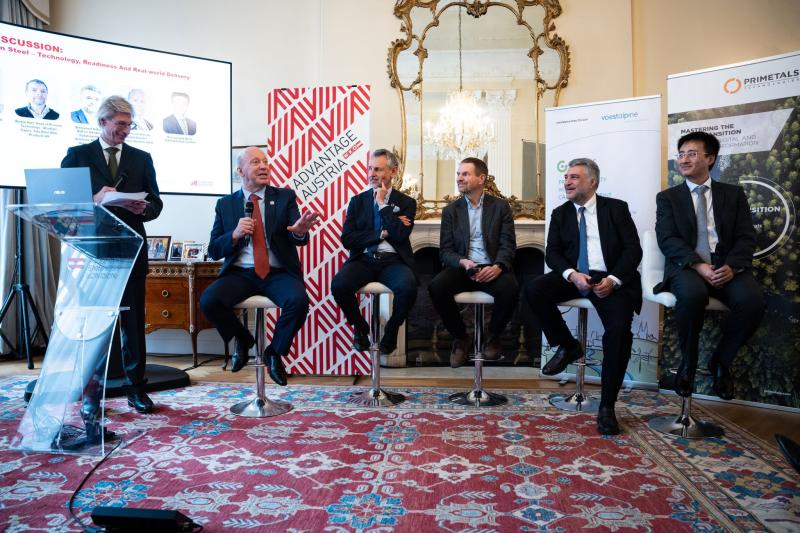
Green Steel: From vision to delivery — Europe’s next industrial test
London offered a useful reminder that “green steel” is no longer a slogan in search of a technology. The technologies exist, in pilot plants, first industrial deployments and increasingly mature engineering roadmaps. The real question is whether Europe can translate these pathways into reliable, bankable and scalable industrial delivery, while remaining competitive in a global steel market shaped by overcapacity, subsidies and uneven climate ambition.
The Austrian Trade Commission in London (ADVANTAGE AUSTRIA) is to be commended for convening this discussion at a critical moment for the steel sector. Hosting the event at the Austrian Embassy, the Ambassador provided a timely and highly appropriate setting for a prominent panel addressing the strategic challenges of green steel.
In this sense, green steel has become Europe’s next major industrial test: a practical exercise in aligning energy systems, trade policy, infrastructure, finance and industrial capability, at speed.
Multiple pathways, one objective
A persistent misconception is that the sector needs a single “green steel solution”. In reality, Europe’s transition will be portfolio-based, combining different pathways depending on site configuration, product mix, scrap availability, ore quality and , above all — energy context.
1) Immediate CO₂ reductions: optimising existing assets
The first pathway focuses on extracting rapid emissions reductions from existing installations. Process optimisation, digital control, yield improvements and higher scrap utilisation can already deliver meaningful CO₂ savings. In integrated plants, limited hydrogen injection and burden optimisation can further reduce coke consumption. These measures do not deliver climate neutrality, but they buy time, capability and credibility.
2) Electrification at scale: Electric Arc Furnaces
The second pathway relies on Electric Arc Furnaces (EAFs), using scrap and/or Direct Reduced Iron (DRI) or Hot Briquetted Iron (HBI). When supplied with low-carbon electricity, EAF-based production significantly lowers emissions. However, scrap availability and quality constraints remain real, especially for high-grade steels, and competition for scrap is increasing globally. In practice, the key bottlenecks are often grid capacity, permitting and electricity prices — not furnace technology.
3) Hydrogen-based ironmaking: H₂-DRI
Hydrogen-based direct reduction (H₂-DRI) is the most emblematic green steel route. Technically proven, it depends on system readiness: affordable hydrogen, continuous supply, storage and logistics. Hydrogen is a powerful reducing agent but an expensive energy carrier. If produced from renewable electricity, green steel becomes inseparable from the transformation of the power system itself.
4) Smelter and hybrid routes
Emerging smelter-based and hybrid concepts address constraints related to ore quality, energy efficiency and process integration. They may become relevant where high-grade ores are scarce or where integration into existing industrial flows is decisive.
5) Carbon capture as a bridge
Carbon Capture and Storage (CCS) and Carbon Capture and Utilisation (CCU) can serve as transitional tools for selected assets, particularly where blast furnaces remain in operation for longer. They are not substitutes for structural change, but can help manage the transition if infrastructure is real and scalable. Across all pathways, the conclusion is clear: the challenge lies not in invention, but in industrialisation and system integration.
Energy: the decisive constraint
Green steel is electricity-intensive, and hydrogen-based routes amplify this reality. Three questions dominate:
• Availability: Can grids deliver stable, industrial-scale power?
• Price: Can Europe secure electricity at competitive levels?
• Speed: Can permitting and infrastructure expansion keep pace with industrial investment cycles?
Where energy prices determine investment locations, energy policy becomes industrial policy. Steelmakers increasingly need long-term partnerships with utilities, hydrogen producers and network operators. The transition is no longer a plant-level project, but a system project.
CBAM, trade and competitiveness
With the Carbon Border Adjustment Mechanism (CBAM) entering its definitive phase in 2026, Europe has introduced a crucial instrument to address carbon leakage. CBAM aims to level the playing field by aligning carbon costs for imports with those faced by EU producers under the EU Emissions Trading System (ETS).
CBAM strengthens the investment case for low-carbon steel, improves transparency of embedded emissions and encourages international convergence. However, its credibility depends on being watertight: scope gaps, administrative complexity and circumvention risks must be addressed decisively.
Crucially, CBAM does not resolve export competitiveness. As long as CBAM does not address export competitiveness, the continued free allocation of CO₂ allowances for energy-intensive industries such as steel remains necessary to prevent carbon leakage via exports and investment decisions.
This is not a contradiction, but a necessary complement to CBAM until a WTO-compatible export solution or broader global carbon pricing emerges.
Global overcapacity and unfair competition.
Europe’s steel transition takes place against a backdrop of persistent global overcapacity and heavy state intervention. In such a market, climate ambition must be accompanied by effective trade defence. Anti-dumping measures, safeguards and strict enforcement of fair competition are prerequisites for sustaining green steel investment in Europe.
Best practice without slogans
Recent European initiatives illustrate how different parts of the value chain are engaging with this challenge. Technology providers such as Primetals Technologies are advancing scalable engineering solutions and hybrid transition concepts. Steelmakers like voestalpine focus on stepwise electrification and high-value product strategies aligned with customer demand, while groups such as Tata Steel are restructuring legacy integrated sites toward lower-carbon production models under complex energy and market conditions. These examples underline that green steel is not a theoretical exercise, but an operational one.
Europe’s opportunity
Europe possesses world-class industrial know-how, leading technology suppliers and steel producers capable of delivering high-performance products. If energy policy, infrastructure investment, trade defence and market creation are aligned, green steel can become a pillar of Europe’s industrial future.
Green steel in Europe will not fail because of physics. It will succeed or fail because of coordination, competitiveness and credibility.
Dr. Roman Stiftner is Managing Director of the Austrian Mining and Steel Association (WKÖ) and Director General of EUMICON. He also holds several European-level functions, including Vice President of Euromines. He is an expert on European industrial, energy and trade policy.